

What is amber?

Baltic amber
why not Danish amber?
The amber we work with at Ravgaard is Baltic amber. The name can be a little confusing, especially when a piece has actually been found on a Danish beach.
Amber found in Denmark is often referred to as Danish amber, and the term Nordic amber is also widely used. These names make sense in everyday language because they describe where the amber was found or its connection to our part of Northern Europe. Geologically, however, it belongs to the much larger group known as Baltic amber.
Baltic amber is not named after the exact place where a particular piece was found. It describes the type of amber and the geological context it belongs to. The same type of amber is found across a broad area around the Baltic and North Sea regions, including Denmark, Germany, Poland, Lithuania, Latvia and the Kaliningrad region of Russia.
So a piece can be found here in Denmark and quite naturally be called Danish or Nordic amber, while still being Baltic amber in the geological sense.
How old is Baltic amber, really?
A mass extinction ends the age of the non-avian dinosaurs. Birds survive.
Resin from ancient forests is preserved and gradually develops into Baltic amber.
The warm Eocene world changes dramatically as global temperatures fall.
By this point, some Baltic amber has already existed for millions of years.
Repeated glaciations reshape Northern Europe and help redistribute much older amber deposits.
Modern humans enter the story remarkably late compared with the age of Baltic amber.
Baltic amber is still found along Danish shores and in the landscape millions of years after its story began.
Timeline not shown to scale.
For the curious
Newer research has dated some of the most important Baltic amber-bearing layers more precisely to around 35–38 million years ago. We use the broader range of 35–47 million years because Baltic amber comes from deposits that have been dated somewhat differently, while research continues to refine the picture.

Which trees produced Baltic amber?
Millions of years ago, the forests that produced Baltic amber looked very different from the landscapes around the Baltic today. But exactly which trees produced the resin is still an open scientific question.
For a long time, Baltic amber was linked to an extinct “amber pine” called Pinus succinifera, a name that still appears in older books and descriptions of amber. Newer research has made the picture more complex. Scientists have pointed to several possible groups of conifers, including relatives of the modern Japanese umbrella pine as well as members of the pine family.
Researchers have not yet identified a single definitive “amber tree”. Our understanding of these ancient forests continues to develop as new methods allow scientists to study amber in greater detail.
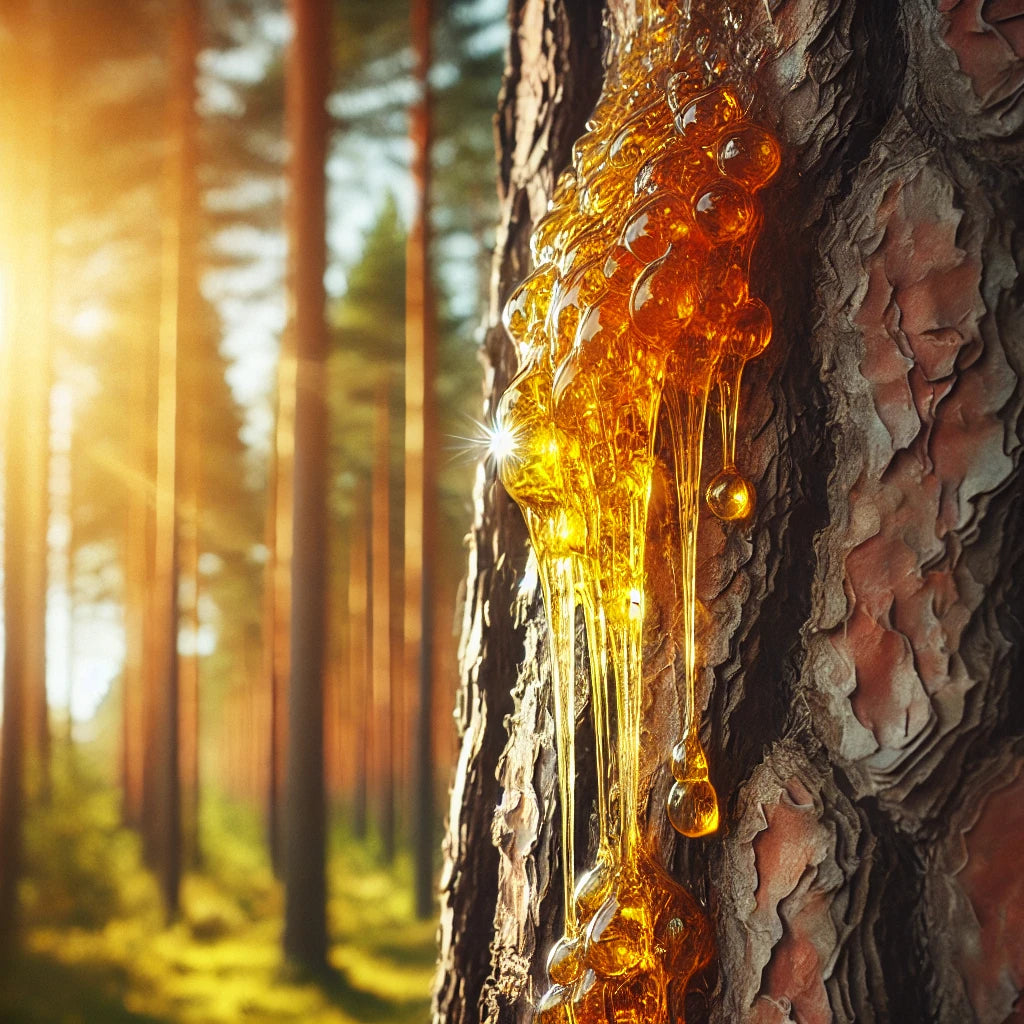
From resin to amber
Fresh tree resin is not amber, and time alone is not enough to turn it into amber.
For resin to survive for millions of years, it first has to escape decay. If it is preserved and buried in sediment, a very slow process of chemical change can begin. Some components are gradually lost, while the molecules that remain become more strongly connected.
Over geological time, the resin changes both chemically and physically until it becomes the more stable organic material we know as amber.
The process is influenced by the resin itself, the surrounding sediment, temperature and pressure. This is why there is no exact number of years at which resin suddenly becomes amber.
For the curious
Part of this slow chemical maturation involves processes known as polymerization and cross-linking. You can picture it as a molecular network gradually becoming denser and more stable as the original resin changes into amber.
What is amber actually made of?
AMBER AT A GLANCE

Organic, not mineral
Fossilized tree resin

Main elements
Carbon · Hydrogen · Oxygen

Hardness
About 2–2.5 on the Mohs scale

Specific gravity
Around 1.08

Refractive index
Around 1.54
Inside Baltic amber
Amber may look simple, but chemically it is a complex organic material. This is a simplified look at some of the features that characterize Baltic amber.
The chemical formula for succinic acid. In Baltic amber, most of it is not present as free succinic acid but forms part of amber’s complex structure.
A commonly used simplified formula. Amber is not one single molecule, so it does not have one completely fixed chemical formula.
Over millions of years, chemical changes linked many of the original resin molecules together into a more stable network.
Baltic amber is characterized by a relatively high content of succinate compounds.
Conceptual illustration – not a literal model of amber’s molecular structure.
For the curious
Baltic amber is a natural polymer made from a complex network of organic compounds derived from ancient tree resin. Much of this structure is associated with plant compounds known as labdanoid diterpenes, while the amber also contains other organic substances such as terpenoids, acids, alcohols and esters.
Baltic amber is also known as succinite because of its characteristic content of succinate compounds. Succinic acid has the chemical formula C₄H₆O₄, although most of it in Baltic amber is not present as free succinic acid, but is bound within the amber’s complex polymer structure.
You may also see C₁₀H₁₆O used as a simplified formula for amber. It is useful as a shorthand, but amber is not one single molecule and does not have one completely fixed chemical composition.

How did amber reach Denmark?
The forests that produced Baltic amber were not necessarily located where the amber is found today.
After the resin had been buried and gradually transformed into amber, it did not simply remain in one place. Over millions of years, rivers, changing seas and coastlines moved amber together with sand and other sediments. Much later, the enormous ice sheets of the Ice Ages, followed by meltwater, moved and redeposited some of it again across Northern Europe.
So there was not one single journey from an ancient amber forest to Denmark. A piece may have been moved, buried, exposed and moved again several times before eventually ending up where we find it today.
This is why Baltic amber can now be found along Danish shores, in the sea and also inland, even though the landscape in which the original resin formed looked completely different from Denmark today.
For the curious
Geologists use terms such as reworking and redeposition when older material is eroded from one layer and later deposited somewhere else. Baltic amber can therefore be much older than the sediment in which it is eventually found.
This repeated movement is also one reason why it can be difficult to reconstruct one exact route from the ancient amber-producing forests to a particular piece found in Denmark.

-

Baltic amber
35–47 million years old
Northern Europe
Also known as succinite.
Baltic amber has an exceptionally wide range of colors and appearances, from clear golden amber to cloudy, milky, and almost opaque pieces.
It is also rich in biological inclusions and has a characteristic chemistry that distinguishes it from many other fossil resins.
-

Dominican amber
About 15–20 million years old
Dominican Republic
Often remarkably clear, with warm yellow and golden tones. Some rare pieces are famous for showing an intense blue fluorescence under certain light.
Dominican amber formed from resin produced by ancient tropical trees and is well known for beautifully preserved insects and other inclusions.
-

Mexican amber
About 20–24 million years old · Chiapas, Mexico
Often clear and golden to orange, although its appearance can vary considerably. Some Mexican amber can show blue or greenish fluorescence.
Like Dominican amber, it is associated with ancient Hymenaea trees and can contain exceptionally well-preserved tropical plant and animal life.
-

Myanmar amber
About 99 million years old · Myanmar
Much older than Baltic amber and formed during the Cretaceous Period, when dinosaurs still lived. It is often yellow, orange, reddish, or brown, but its appearance varies widely.
Myanmar amber is especially famous for extraordinarily ancient inclusions, including insects, plants, feathers, and small vertebrates.


Amber across nearly 400 million years
Can dinosaur DNA really be preserved in amber?

It is one of the most famous ideas associated with amber.
In Jurassic Park, dinosaurs are recreated using dinosaur blood found in mosquitoes that had been trapped in amber for millions of years.
Amber really can preserve extraordinary detail. Insects, feathers, plant material, skin structures, and microscopic features can sometimes still be studied millions of years later.
But preserving physical detail is not the same as preserving intact DNA.
In the 1990s, several studies claimed to have recovered very old DNA from insects in amber. Later attempts to repeat those results were unsuccessful, and contamination with modern DNA became the most likely explanation.
Studies of much younger copal also show that DNA breaks down relatively quickly and is difficult to preserve over geological timescales.
Today, there is no scientifically accepted evidence of dinosaur DNA preserved in amber.
What amber can preserve is still remarkable. Tiny traces of ancient life, together with color, bubbles, plant material, and internal structures, can offer a glimpse into environments that disappeared millions of years ago.
Continue exploring amber
-

Colors & Inclusions
Discover what creates amber’s colors and what can be preserved inside it.
-

From Raw Amber to Jewelry
See how we cut, sand, and polish amber in our workshop.
-

How to Find Amber
Learn where, when, and how to look for amber along the coast.
-

Genuine Amber & Imitations
Learn more about genuine amber, treatments, and common imitations.


